Dyslexia and Learning Difficulties
Adults might not have learned to read for a variety of reasons ranging from physical impairment to lack of proper training to poor self-esteem.
Physical impairment… For the past year and a half I have been reading everything I can find about dyslexia. The simple definition is that dyslexia is a reading disorder affected by impaired vision and hearing. There are degrees of dyslexia from mild to severe, and experts cannot agree on what causes the condition. Some people have impaired eyesight that can be corrected with prescription eyewear; and hearing trouble that can be corrected with auditory devices. Some experts like to quip that dyslexia occurs in an area in the brain where the “wires are crossed,” yet, many dyslexics are gifted in other areas, such as, mathematics, music, dancing, sports, and public speaking. There are a lot of famous people who had learning difficulties: Whoopi Goldberg, Charles Schwab, Andrew Carnegie, Ben Carson, Albert Einstein, Jim Carrey, Danny Glover, Steven Spielberg, Mohammed Ali, Henry Winkler…
Teachers and others in society need to be trained to check for dyslexic symptoms so, that the problem can be arrested early to prevent a lifetime of misery.

Poor self-esteem… Children who suffer with dyslexia or apparent difficulty learning to read learn early in life how to hide the problem. Feelings of embarrassment, isolation, being left behind their peers, and anger can manifest into poor self-esteem and defeatism. Why is it so easy for others to read and yet I can’t. What is wrong with me? They think they are different, dumb, yet they are brilliant at coping with the problem of dyslexia and hiding it from everyone… teachers, included…. For years! They create different excuses to get out of reading/writing assignments or tasks: skipping school, losing assignments, acting out or becoming the clown in class, pretending to be sick, etc. Eventually they may give up on learning how to read because it is just too painful of a process. They’ve learned to hide the reading difficulty so well that they grow up to become illiterate adults that will come to a literacy council for help, one day. Hopefully.
 Lack of training…. Some of the adults we tutor in basic reading have never been trained to read from the left to the right side of words, sentences and pages. They haven’t been taught that in the English language, we also read from the top of the page to the bottom. Children should have had years to absorb the mechanics of reading as they were read to before they entered kindergarten. Adults who did not receive structured training, or who weren’t ready for formalized schooling sometimes get left behind their peers when it comes to learning to read. How can you see the difference, or hear the difference between letters and sounds, when you have never been taught to do so? And if one is learning to read English as a second language, there may be more difficulties.
Other languages may have a different arrangement than English, which can cause a lot of confusion in learning to read. (The Hebrew language is read from the opposite side of the book as compared to English. Sentences are read from the RIGHT to the left in Hebrew. Descriptive phrases and adjectives come after the subject in Spanish, which can lead to more confusion. “My mother’s house” would be translated into “house of my mother” or “casa de mi madre” in Spanish…) English also uses alphanumeric characters, where other languages may use Arabic, Chinese, Japanese, Hebraic, and other symbolic characters.
An American public school teacher with 20+ students per class does not have the time to correct each student’s learning problem. Hopefully, the teacher will recognize and alert the proper team that there is a problem so that the student will receive help. However, I have talked with a few adults who were too ashamed to admit they had problems reading while in school. They hid the problem from others, and became a high school graduate who could not read!
As Anne Arundel Literacy Council (AACLC) tutors we want to take all of these things into consideration as we work one on one to make friends, earn trust, and help students get the training they need to succeed in learning to read, or read better. Be a compassionate, positive influence in your student’s life. It takes a great deal of courage to admit that one cannot read, or has trouble reading. Yet, today, there is more help available than ever before to correct reading problems. Some resources are listed on the Tutor Resources portion of the AACLC website at ICANREAD.org.
I suggest you take the Dyslexia test on the following link, you may find that you have a form of dyslexia or not: http://www.dyslexicadvantage.org/dyslexia-test/ You will gain some insight into questions to ask students about the problems they are experiencing in learning to read, better.
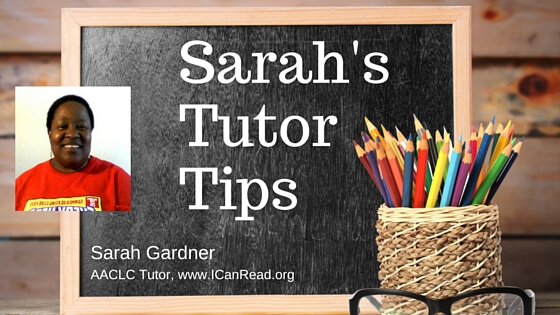
Sarah Gardner

Tutor Sarah Gardner